Port Dundas and the Glasgow Whisky History: The City That Fed the World with Whisky (and Its Cows with Alcohol)
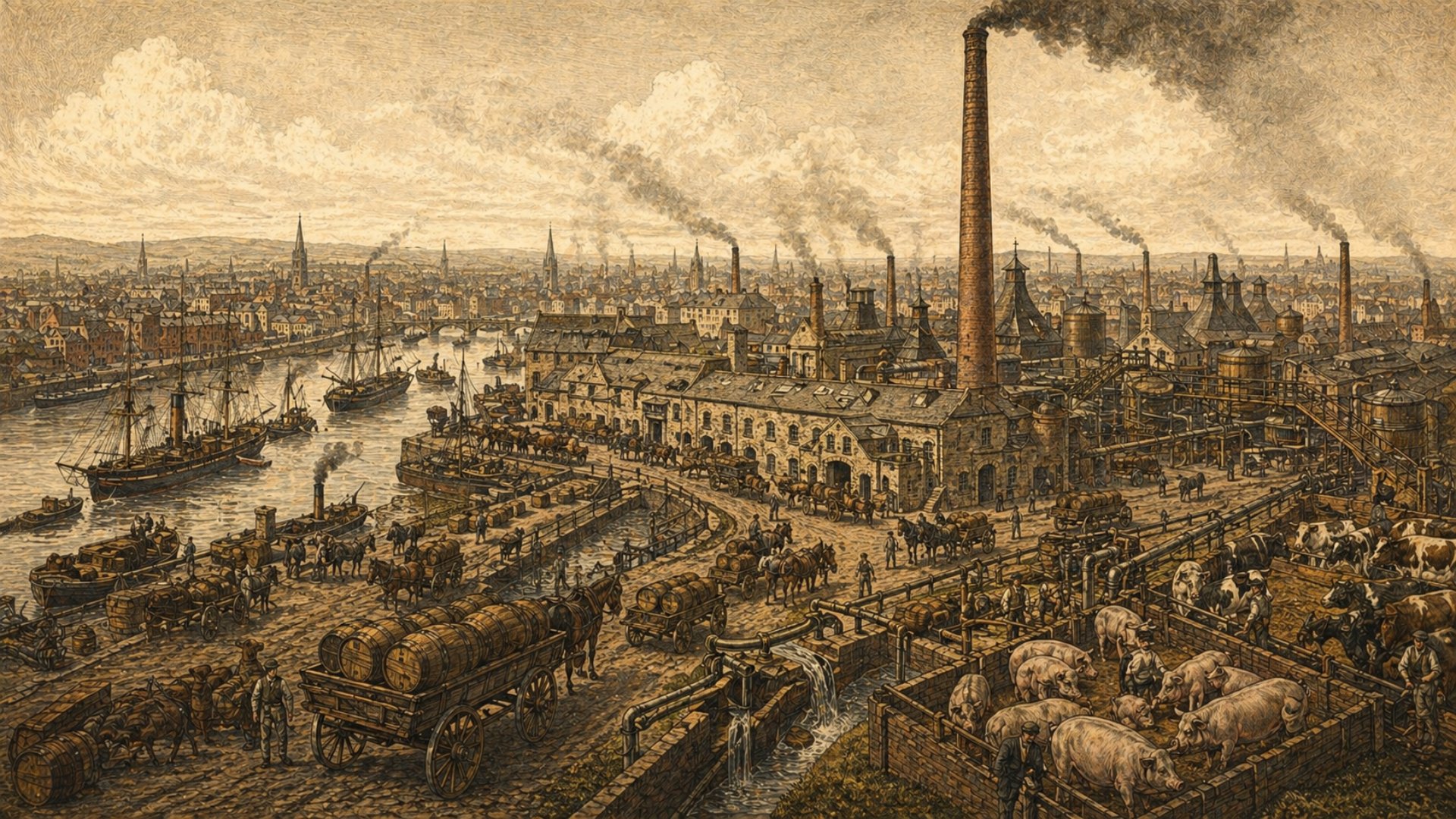
Port Dundas was once one of the most important names in Scotch whisky, yet today it is barely remembered. Rising above Glasgow’s canals and industrial skyline, this vast distilling complex helped define modern whisky production through scale, innovation, and export power. To understand Glasgow whisky history, you have to start with Port Dundas.
Port Dundas: Glasgow’s Forgotten Whisky Giant
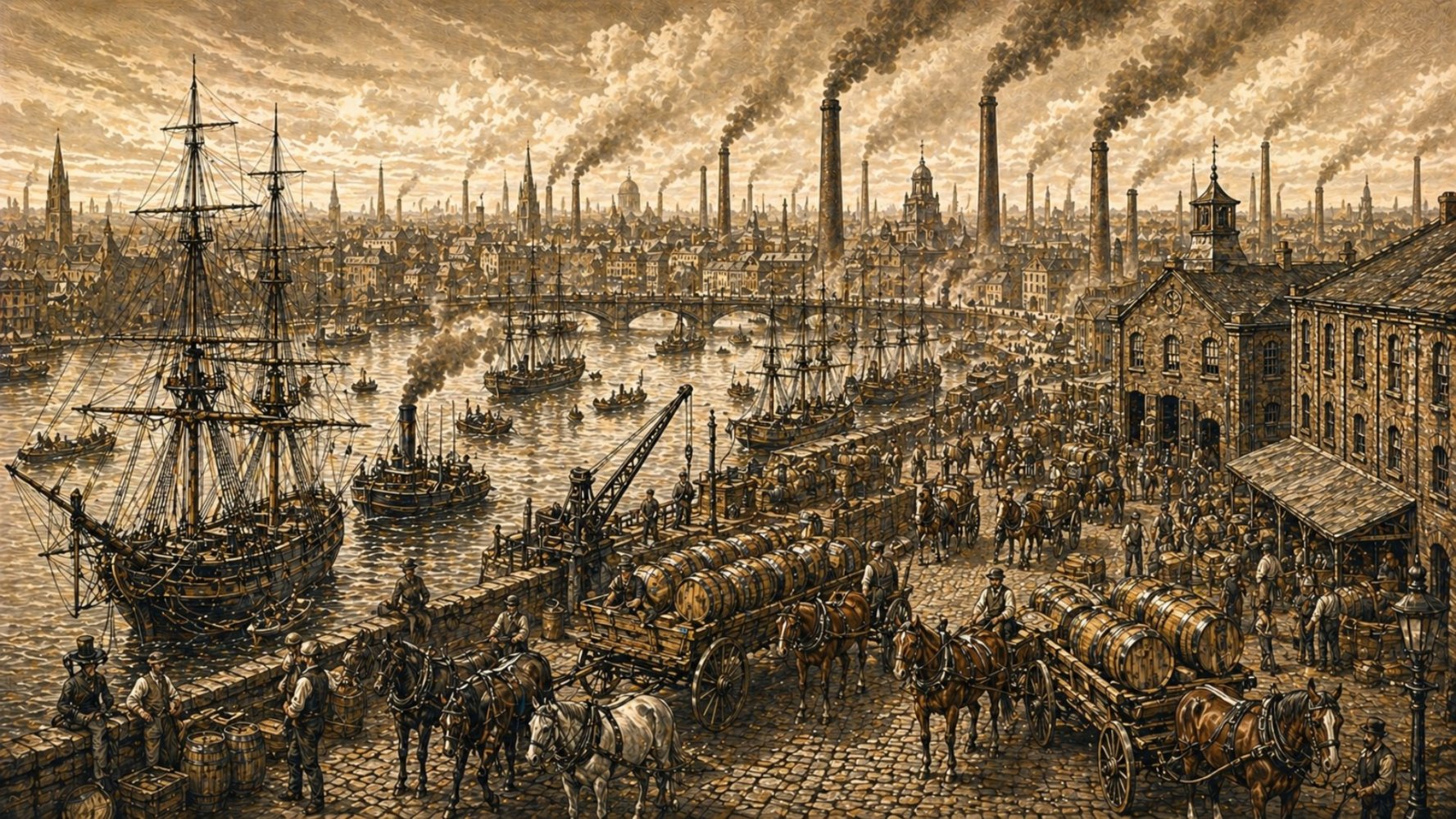
AI-generated image: The River Clyde was more than a waterway; it was whisky’s highway to the world.
When we close our eyes and picture the origins of Scotch whisky, we see postcard scenes of heather-covered hills, romantic mist, and small stone distilleries. But this image, crafted by modern marketing, obscures the truth that the heart and engine of whisky’s global journey lie in Glasgow’s industrial past, particularly in Port Dundas and the River Clyde.
The real whisky story was not born solely in the countryside; it was shaped in the smoke, iron, and coal of the city. More than a shipping port, the city was the industrial powerhouse where whisky evolved from a local curiosity into a world-spanning product.
This is the story of Port Dundas and Glasgow’s forgotten whisky empire: a mighty, foundational force in whisky’s history that has been all but erased from the official narrative.
Invisible Giants: The Mega Chimney of Port Dundas
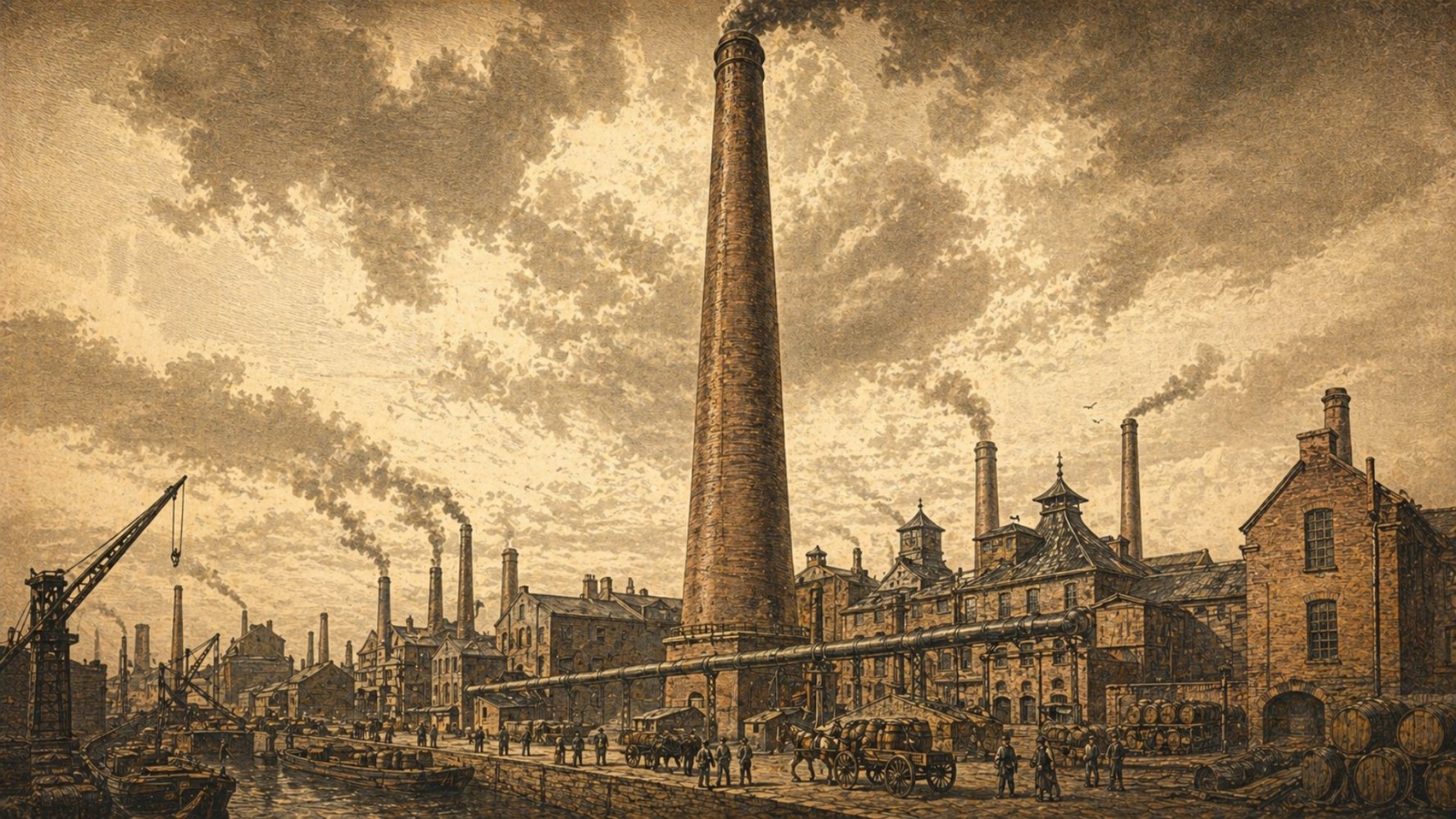
AI-generated image: Port Dundas reached for the sky with one of Europe’s tallest industrial chimneys.
In the 19th century, Glasgow didn’t produce whisky by the barrel; it produced it by the ocean.
While the rest of Scotland worked on farms through the early 1800s, the Port Dundas area rose as a centre of alcohol production in the 19th century. Here stood two colossi that are now barely rumblings in the history books: Dundashill (taken over by the original Glasgow Distillery Company in 1825), once the largest malt distillery in Scotland, producing unpeated, peated, and triple-distilled single malt whiskies, and Port Dundas, which, alongside the Caledonian distillery, formed the biggest distilling operation in the country by the late 1800s.
To understand Glasgow’s ambition, you only had to look up. Rising above the Port Dundas complex was a 138-metre brick “Mega Chimney”, a structure built not out of pure necessity, but as an architectural challenge. It was designed to rival the height of Cologne Cathedral (157.38 m), making it one of the tallest human-made structures in Europe at the time.
It was an industrial declaration of war. Glasgow wasn’t just distilling spirit; it was building monuments to progress.
Whisky, Cows, and Pigs: A Circular Economy Before Its Time
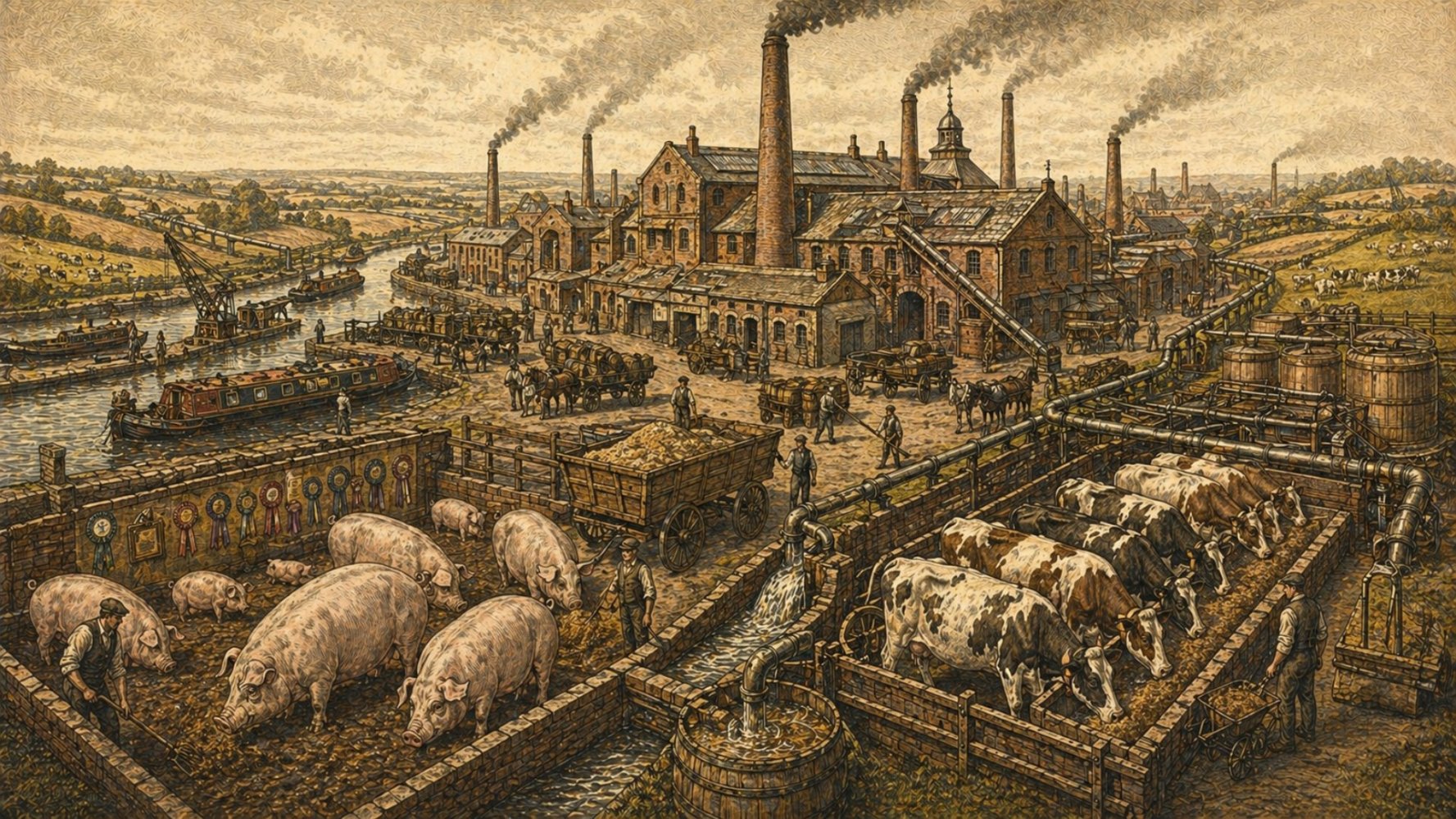
AI-generated image: At Port Dundas, nothing went to waste. Whisky fed the city, and the city fed itself.
What happened at Port Dundas was a miracle of the circular economy long before the term existed.
The site functioned similarly to a living, self-sufficient organism. The leftover grain from distillation (the draff) didn’t go to waste. It fed one of the largest dairy farms in the country: 1,000 cows supplying fresh milk to the entire city.
The complex also housed a piggery with 400 pigs that became the stuff of legend. The author of “The Whisky Distilleries of the United Kingdom“, Alfred Barnard, clearly impressed, recorded:
“Some of them are highly bred animals of great size, and on entering one of the breeding sheds, the visitor is surprised to see the wall literally covered with prize-cards.”
Even the final waste had a purpose: liquid manure was pumped through pipes straight to farms in Possil, while the massive yeast output supplied local bakeries.
Glasgow didn’t just drink whisky, it lived, ate, and breathed it.
Riots, Explosives, and the Paisley Mafia
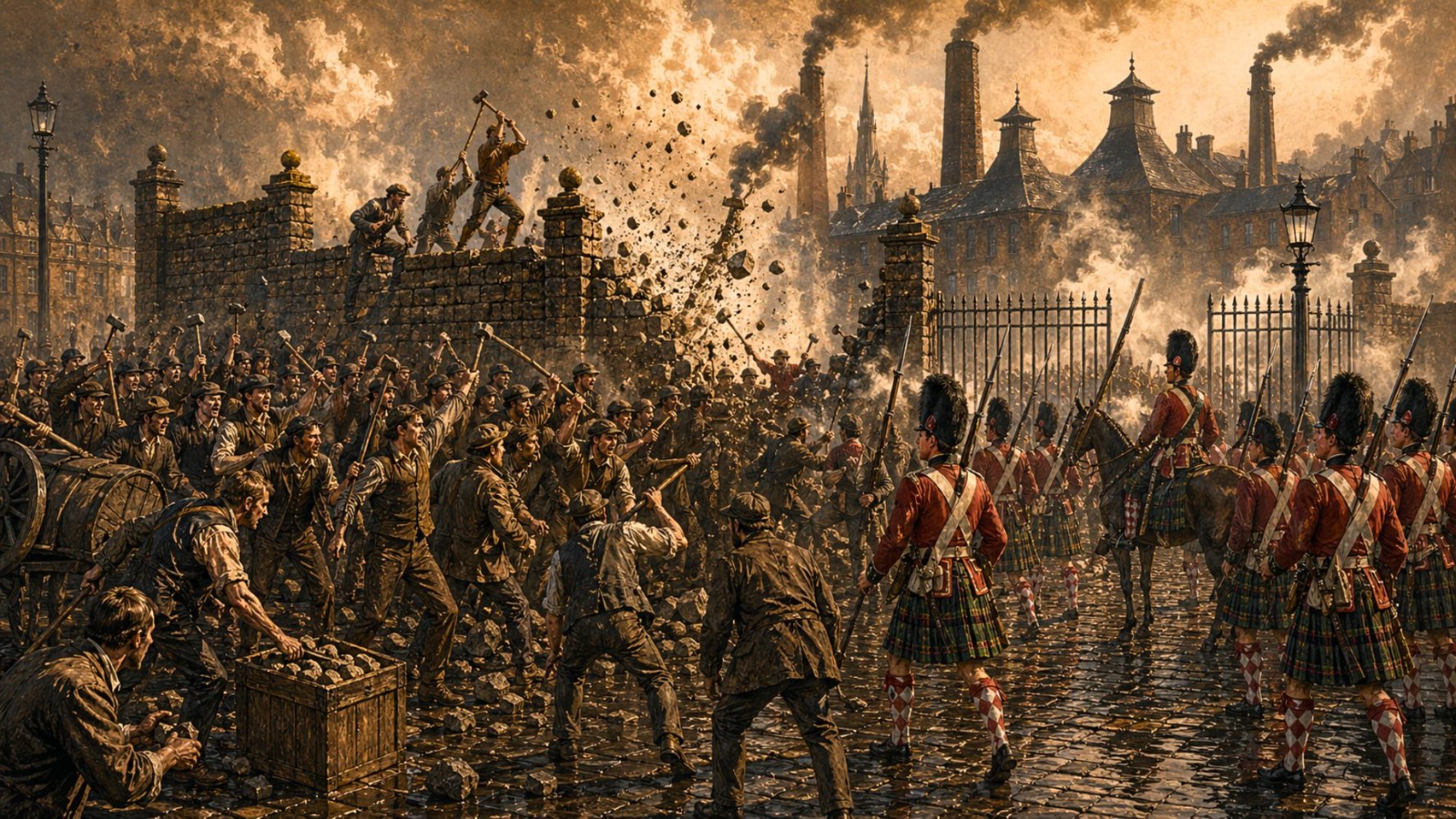
AI-generated image: Whisky history in Glasgow was not always refined. Sometimes it arrived with gunpowder.
The history of these distilleries reads like a thriller.
Thomas Harvey, nicknamed “Lang Tam” for his height, was one of the barons of Dundashill. In an act of arrogance, he built a wall on his Westhorn estate to block local access. The response from Glaswegians was, fittingly, industrial: they showed up armed with explosives to tear it down.
The situation escalated so badly that the army had to step in.
A public boycott of Harvey’s pubs followed, eventually driving him into bankruptcy. But the industry itself remained in the hands of the powerful “Paisley Mafia.”
Three families dominated the trade: the McFarlanes, the Harveys, and the Gourlays. And they did so under an influential matriarchy that history tends to gloss over.
Elizabeth Harvey was already running her distillery by 1798, and it was widely recognised as producing the finest whisky in the region during the early 19th century. Even more remarkable was Marion McFarlane, who, after her husband’s death in the 1800s, took control of M. McFarlane & Co. and ran the largest distillery in Scotland for a quarter of a century.
These women weren’t figureheads; they were the CEOs of the biggest industrial operations of their time.
When Glasgow Whisky Was “Irish.”
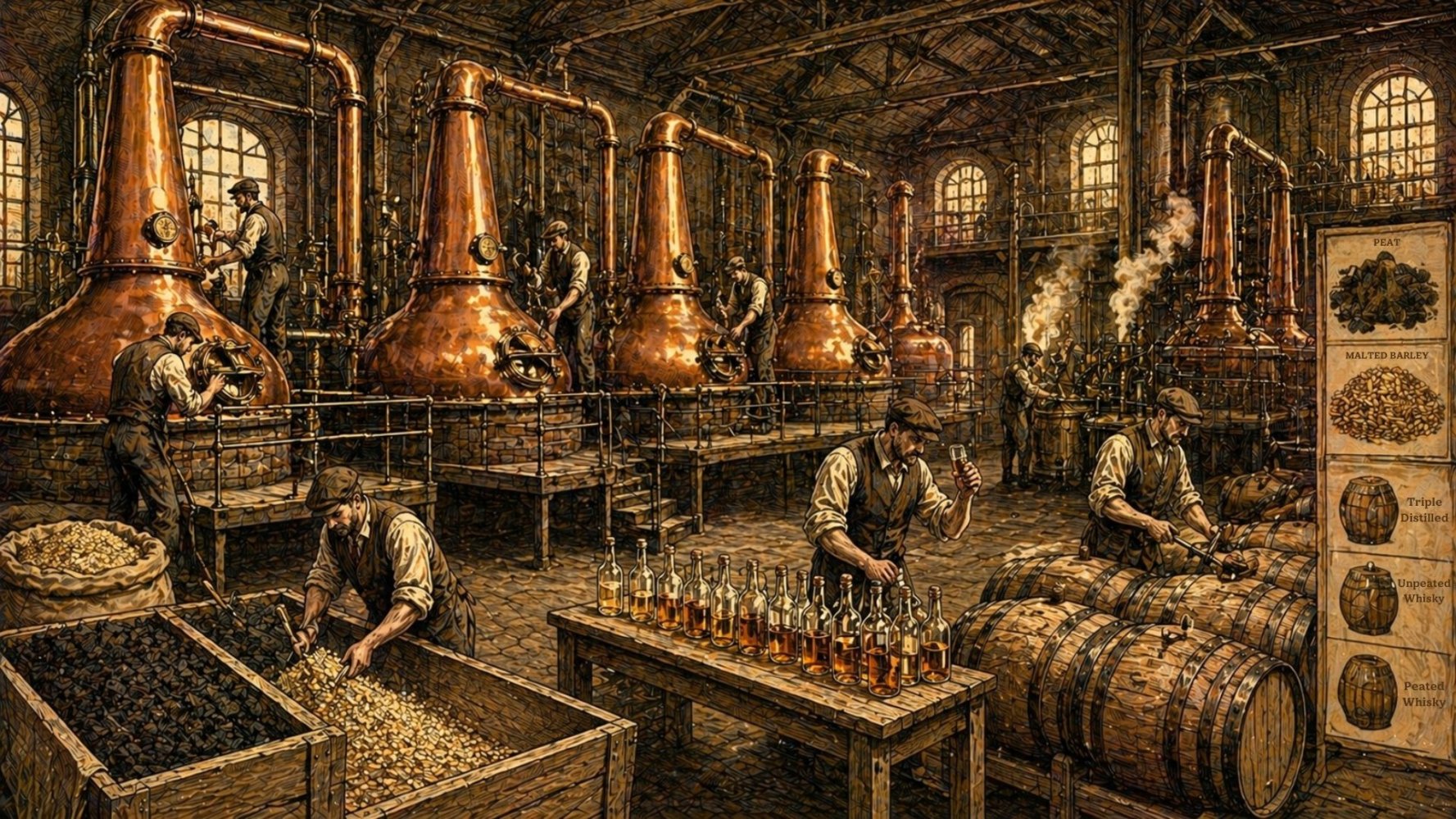
AI-generated image: In Glasgow, whisky was defined by craft and demand, not geography.
Today, we obsess over origin labels. But in 19th-century Glasgow, whisky was defined by style rather than geography.
The city’s distilleries were chameleons. If the market demanded “Highland whisky,” they used peated malt. If consumers wanted an “Irish style,” they ran triple distillations in copper pot stills to produce a lighter, unpeated spirit.
It was all about technique.
Much like how we regard “London Dry Gin” today as a style rather than a place, Glasgow’s distillers saw origin as secondary to demand. Such flexibility is exactly what allowed the city to conquer international markets ahead of everyone else.
From Glasgow to Costello: The Mafia Connection
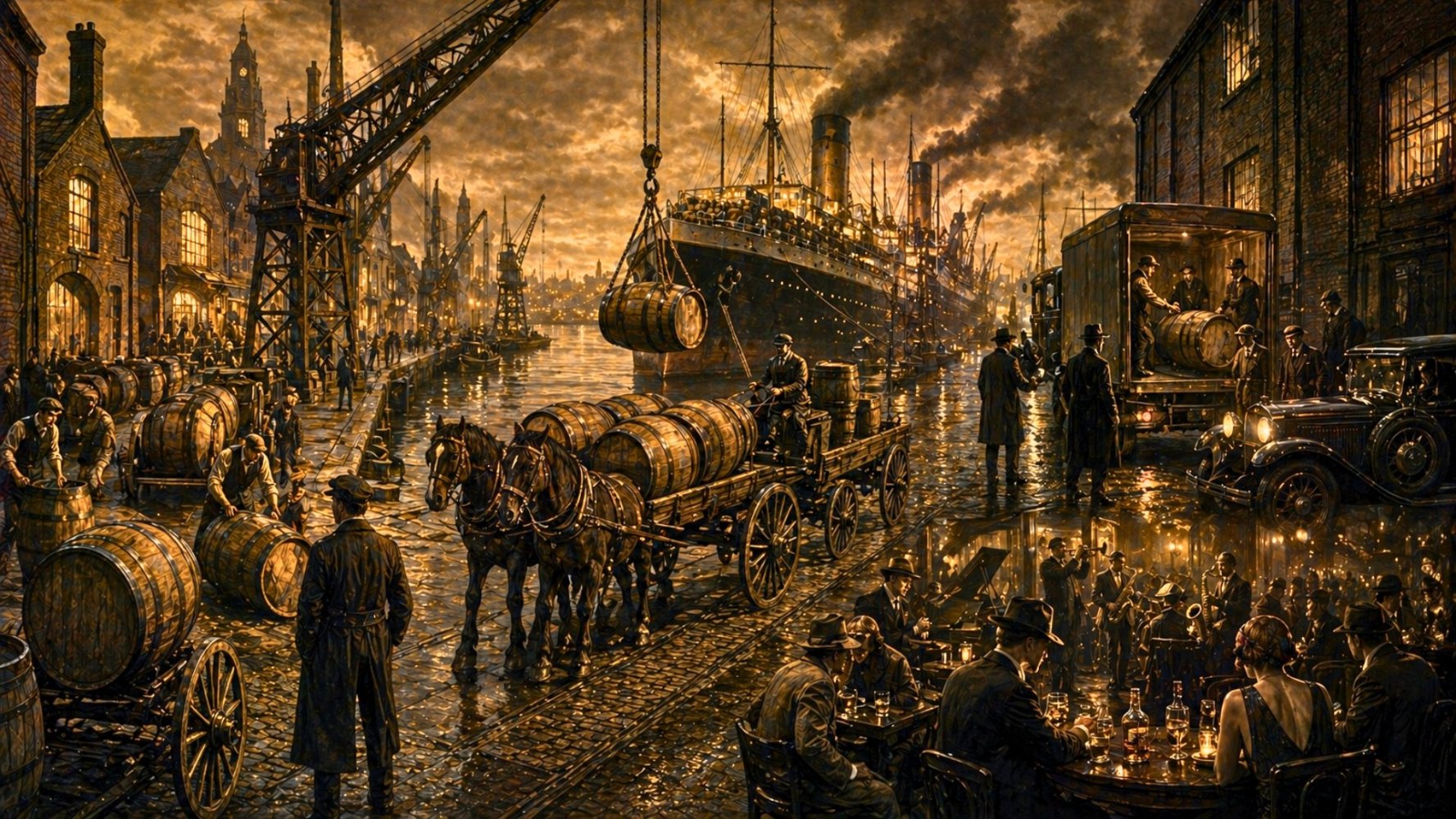
AI-generated image: From the Clyde to the underworld: Glasgow whisky found unlikely customers abroad.
Exports from the River Clyde carried Glasgow whisky into the darkest nooks of American Prohibition.
William Whiteley was an audacious Yorkshire entrepreneur who came to Scotland in the early 1900s to work in the whisky industry in Leith, Edinburgh. Among many whisky-related businesses, his most successful whisky brands were the House of Lords and King’s Ransom, which he sold in considerable volumes in Canada and the US. Among his customers were Charles “Lucky” Luciano and Frank Costello, both Italian-born gangsters who revolutionised American organised crime and are often cited as the godfathers of the modern American Mafia.
By the late 1930s, Whiteley was getting old, so Frank Costello and some of his associates decided they would like to buy the company through a guy named Irving Haim, the only Romanian-born American Jew ever to own a Scotch whisky company. Haim became the frontman, or technically the owner, of William Whiteley Co., supplying King’s Ransom, House of Lords, and other brands to the Americas.
After that, Frank Costello effectively became the brand’s “sales representative,” using laundry trucks to distribute Glasgow whisky through jazz clubs and high-end speakeasies across the US.
The University of Blenders and the Ambassador of China
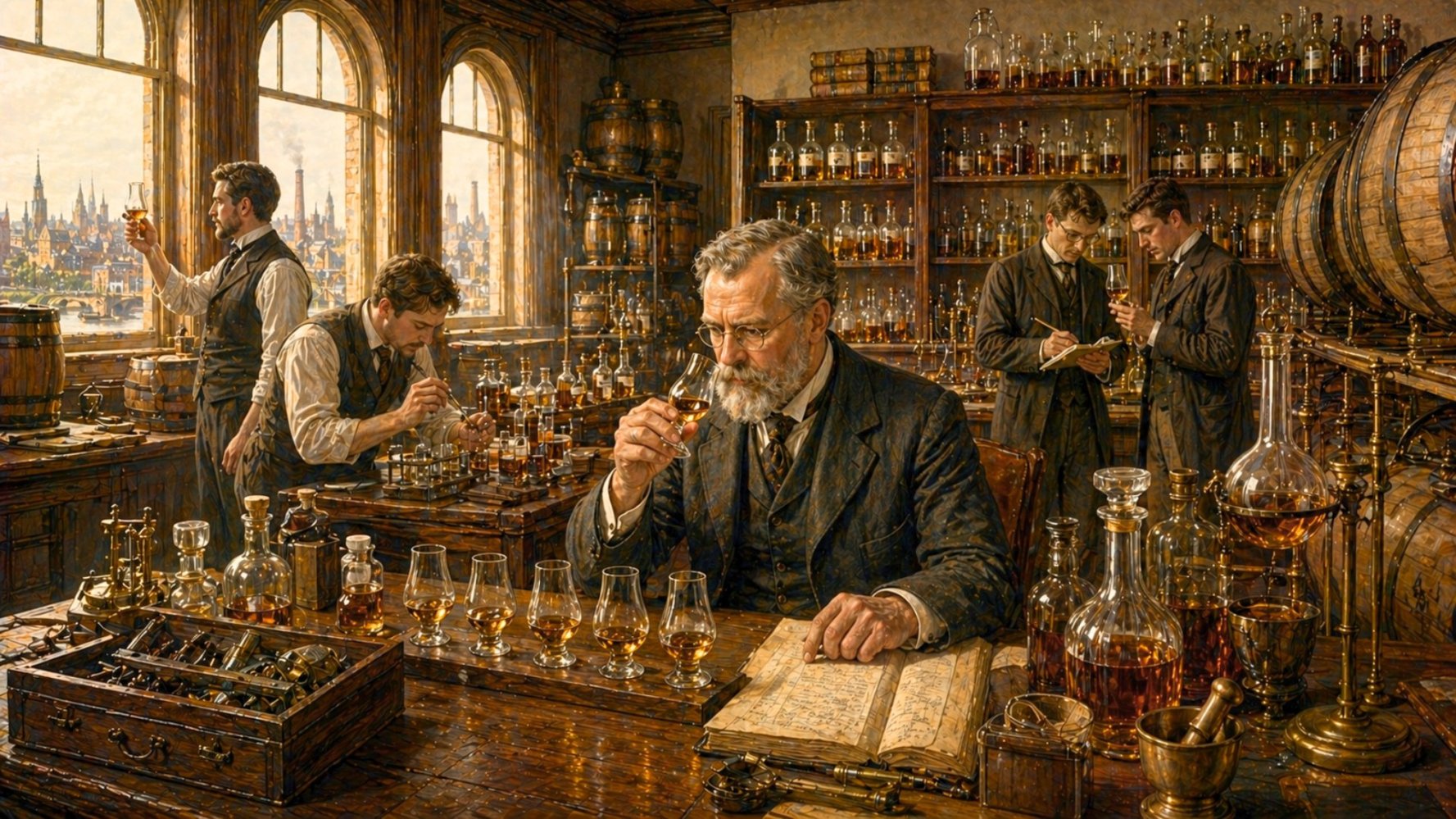
AI-generated image: Glasgow wasn’t just making whisky, it was inventing how the world would drink it.
Glasgow was also the laboratory where modern blending was perfected.
The firm Robertson & Baxter (R&B), established in the mid-1800s, operated like a true “university,” where figures such as the Walker brothers learned their craft. It was here that William P. Lowrie, an innovator in supply chains, pioneered and patented an improved process of wine-seasoning casks in the late 19th century.
If you are curious about the patent’s details, you can find a digital copy here.
As the sherry trade declined and whisky demand exploded, Lowrie began sourcing his own wood and seasoning it himself. A method that remains the gold standard today for giants like Diageo.
Teacher’s was another major player in Glasgow’s blended whisky scene. William Teacher founded the business by opening “dram shops” dedicated to whisky tasting and appreciation. He eventually owned about 20 shops. The succeeding family saw great potential in blending and launched their own brand, Teacher’s Blended Whisky. The business’s success led to the construction of the Ardmore distillery and, later, to the acquisition of the renowned GlenDronach distillery. The company grew extensively, exporting whisky worldwide and becoming especially popular in Australia. By the 1970s and 80s, Teacher’s was likely the second-largest whisky brand in the UK, maintaining a strong presence in other markets as well.
According to Dave Broom and Iain Russell from The Liquid Antiquarian, the scale of these whisky empires was staggering. James Buchanan (Black & White blended whisky) once boasted that his annual output, laid end to end, would stretch 53 miles and that his stacked cases would rise higher than Mount Everest.
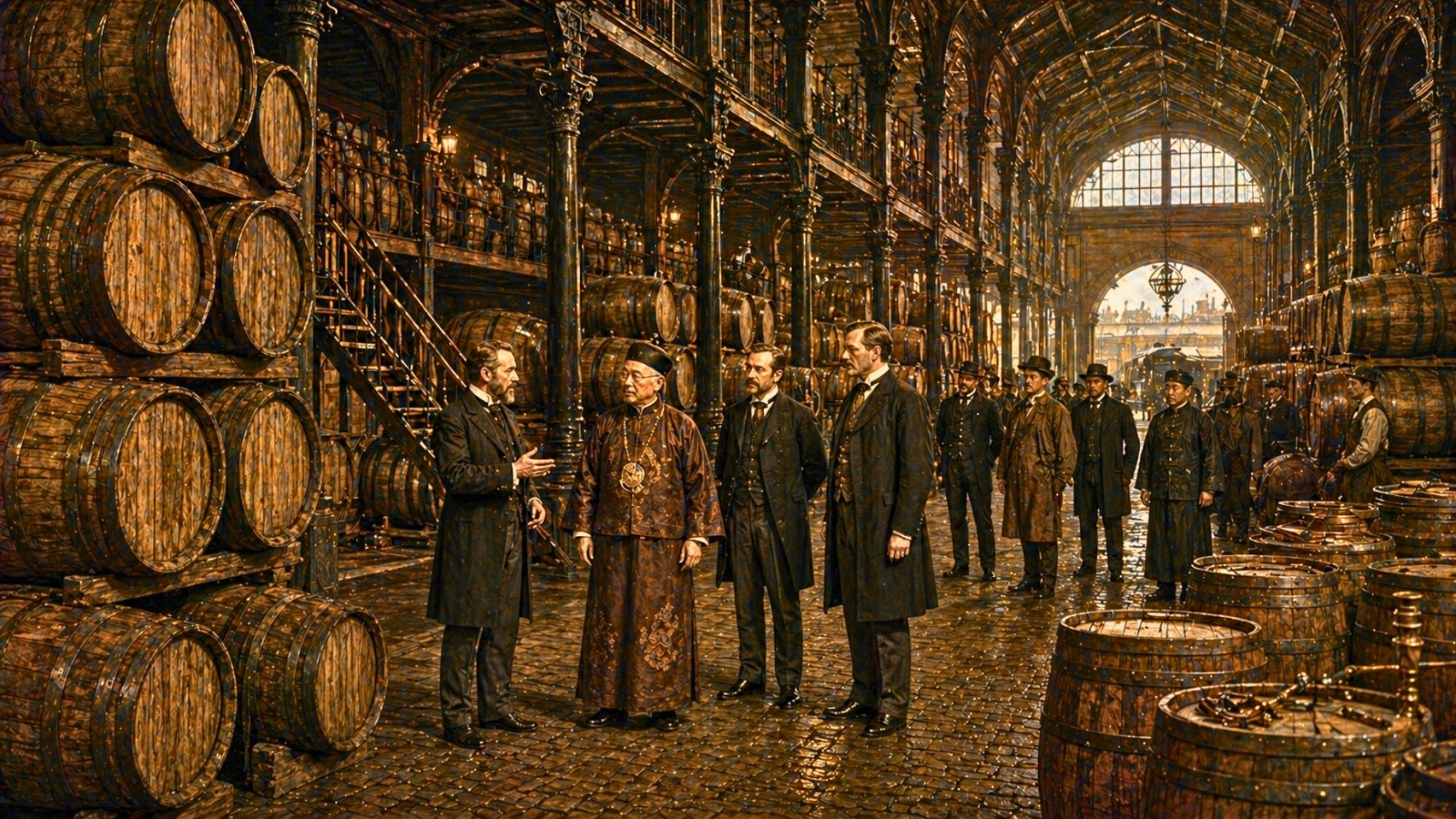
AI-generated image: Even beneath Glasgow’s railway stations, whisky shaped international trade.
Such opulence drew global dignitaries. In 1900, the Chinese Ambassador visited the Greenlees brothers’ (also whisky blenders) warehouses at St. Enoch Train Station (Demolished in 1977). After seeing two million gallons in storage, he said:
“In China, all the best poets could only be got to write the best poetics by spirit.”
China was then opened to trade with the West, and he hoped that the introduction of whisky would help replace other vices like opium smoking. He thought spirits always made people cheerful, whereas opium led to drowsiness. The Chinese market started opening around that time, below what was once Glasgow’s most stunning railway station.
A Return to the River: Glasgow’s Whisky Revival
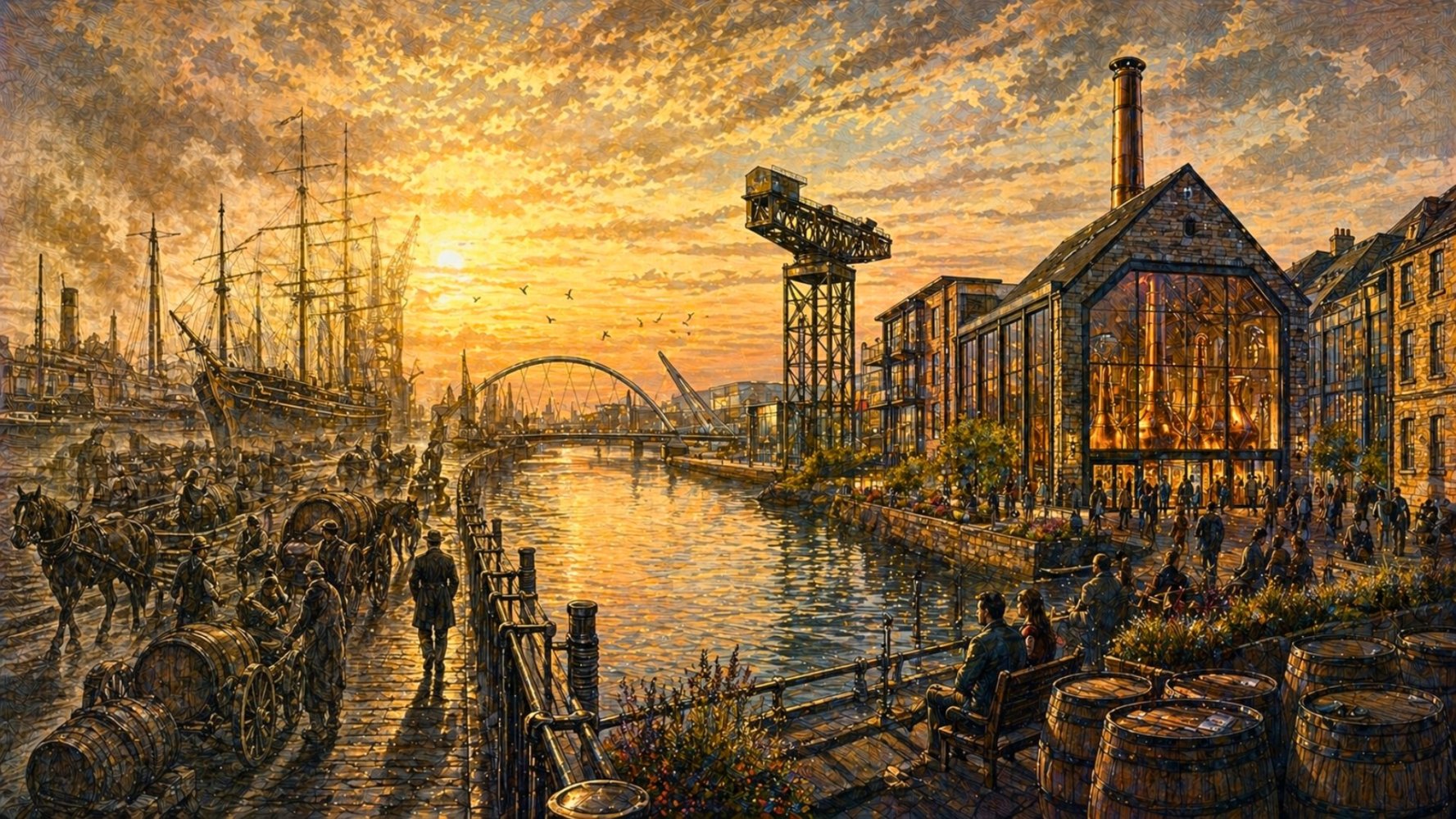
AI-generated image: Glasgow’s whisky story never disappeared; it simply waited to be remembered.
Today, Glasgow is waking from its amnesia.
The opening of the Clydeside Distillery in 2017 is more than just a new business; it symbolises poetic justice. Located on former export docks, filled in with rubble from the old St. Enoch station, it sits on a site where, a century ago, millions of barrels of whisky aged beneath travellers’ feet in the early 1900s.
Walking along the Clyde today, it becomes clear that reclaiming Glasgow’s legacy isn’t about nostalgia. It’s about comprehending the true identity of whisky.
The real question isn’t just why we forgot this industrial giant; it’s whether other stories of urban innovation and power are being ignored while we keep looking to the Highland hills for a past that was, in reality, built in Port Dundas and the city of Glasgow.
Acknowledgements
This blog post is inspired by the fantastic video “Glasgow Whisky History: Lost Industry & Hidden Sites” by the talented Dave Broom (whisky writer) and Iain Russell (whisky sleuth). A heartfelt thank you to both for generously sharing their deep knowledge of the industry through their books, videos and research.
FAQ Section
Why was Glasgow important in whisky history?
Glasgow was once one of Scotland’s largest whisky production and export centres, home to giant distilleries like Port Dundas.
Why is Port Dundas important?
It played a major role in scaling whisky production and shaping modern Scotch whisky.
Does Port Dundas still exist?
The original distillery is gone, but its legacy remains central to Glasgow whisky history.
Is Port Dundas whisky still available?
Yes, there are a few bottles left through some Independent Bottlers and whisky retailers. You can find Port Dundas whisky here and here. Hurry up before it’s too late.
Does Glasgow still make whisky today?
Yes. Modern distilleries such as Clydeside and The Glasgow Distillery Company continue the city’s whisky tradition.
Where can I learn more about Glasgow and its whisky?
You can join us on our Glasgow West End Whisky Tour.